Your goal is to play all the cards in your hand onto playable branches. Watch the coins, respond to doubles, and catch missed calls. The lowest cumulative score after ten rounds wins.
Get the table ready.
Choose the first dealer
Each player draws a card. The player with the lowest card total deals and takes the first turn in the opening round.
Set up the branches
Put the 0/0 card in the center of the table. Set out a coin for each player’s branch and one more for the community, or free, branch.
Deal the hands
Deal seven cards each for 2–4 players, six each for 5 players, five each for 6 players, or four each for 7–8 players.
Set out the draw cards
Put the remaining cards face down in two draw piles on the table. A branch marked with a coin is open to everyone.
Find your next move.
Match, then say NEXT
Match a number in your hand to a playable branch. Playing on your own branch lets you remove its coin and protect that branch. Say “NEXT” when your turn ends.
Remove a coin before your turn ends
Removing your coin is optional after you play on your own branch. Once you say “NEXT,” you cannot remove it; a coin left in place keeps that branch open to other players.
Draw if you do not play
You may choose to draw even when you have a playable card. If you cannot play or choose not to play, draw a card. You may play the drawn card if it matches a playable branch. Say “NEXT” when your turn ends.
Start the community branch at the right time
The community branch may begin only after every player’s branch has started. Any player can start it. Its coin stays permanently in place, so the branch remains open to everyone.
Put your coin out when required
After drawing, if you do not play a card on any branch, place your coin on your own branch before saying “NEXT.” Forgetting creates a COIN penalty opportunity.
Keep your ears open.
Catch a COIN penalty
The first player to call “COIN!” to the player who forgot catches the mistake. The forgotten coin is placed on that player’s branch, and the catcher gives that player one card from their own hand. For tied calls, the catcher with the shortest clockwise distance to the penalized player wins the call.
Catch penalties within the time limit
A mistake must be caught before the next player’s turn ends. After that deadline, the penalty is not enforced. A forgotten coin cannot be forced onto the branch after this window has passed.
Declare UFF-DA!
Say “UFF-DA!” out loud as you play your next-to-last card. This warns everyone that you have only one card left. Forgetting can earn a penalty card.
Catch a missed UFF-DA!
Call “UFF-DA!” before the forgetful player makes their own declaration, and before the next player’s turn ends. The catcher gives the player one card from their hand. Resolve tied calls by the same clockwise-distance rule used for COIN penalties.
A double changes things.
Play a double across a branch
A double splits one branch into two and is laid across the branch. It is the game’s two-card play: after laying the double, add a matching card or draw a card. You may play the card you draw.
Fill both sides of the double
Normal play pauses until both sides of the double branch are filled. A player forced to draw because of an active double does not place a coin for that forced draw.
Handle a double as your last card
If your last card played is a double, draw an additional card to match it. Say “UFF-DA!” before drawing that extra card. If the drawn card matches, you may play it to win the round.
A last-card double with no draw cards
If you play your last card as a double and no draw cards remain for the required extra draw, the round ends and the round’s bonus points are awarded.
Count the friendly rivalry.
Award the progressive bonus
The first player to play all their cards wins the round’s point reduction: 5 points in round 1, 10 in round 2, 15 in round 3, and so on, up to 50 in round 10. The reduction is subtracted from the winner’s score.
Recognize a terminated round
If all draw cards are gone and no card can be played on the table, the round is terminated. No progressive bonus is awarded in a terminated round. An unresolved double can cause this situation.
Begin the next round
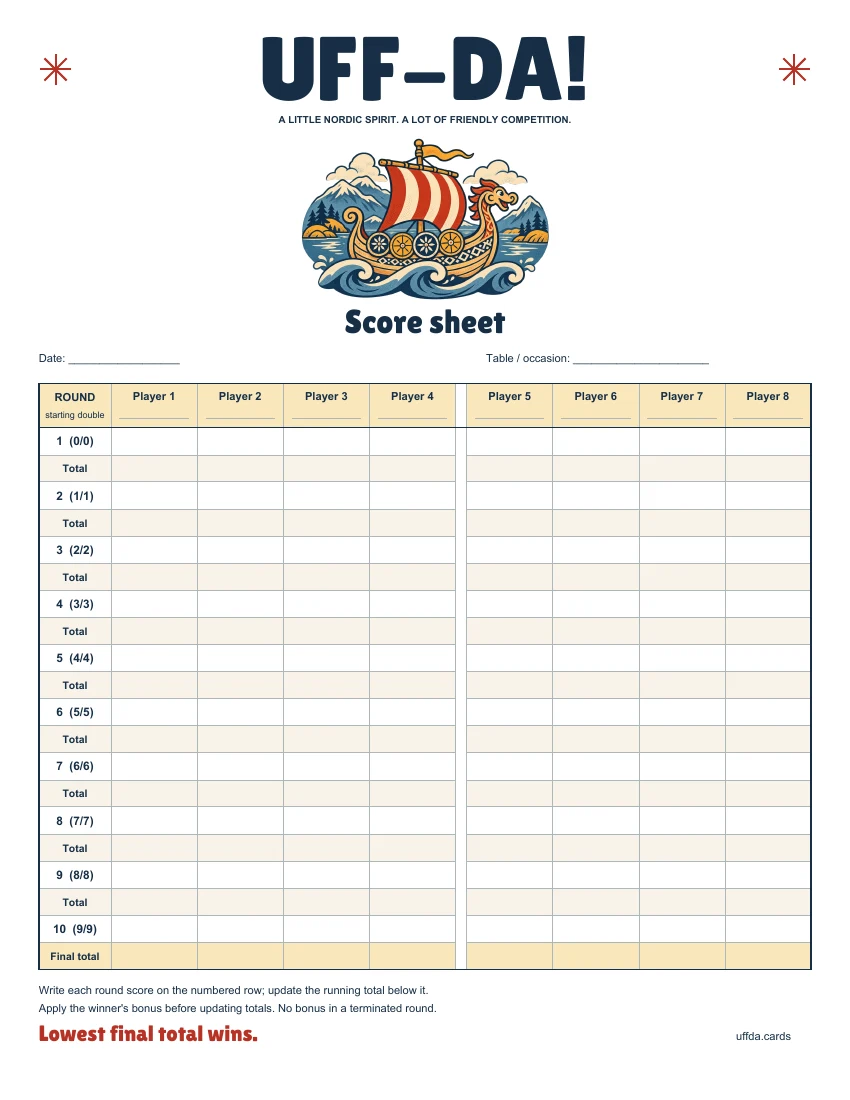
The round winner deals and starts the next round. After a terminated round, the player with the fewest points in that round deals and starts. Replace the center card with the next double: 1/1, then 2/2, continuing through 9/9, and reset the branch coins.
Keep a running total
Total each player’s points after every round and keep a cumulative score. After all ten rounds, the player with the lowest total wins the game.
The Double UFF-DA!
Catching a penalty can put you in the spotlight too. If you have two cards and give one to the player you caught, you now have one card left. Remember your own “UFF-DA!” before releasing that next-to-last card.
If you forget, someone can catch your missed declaration and give you a penalty card in return. The catcher becomes the player being caught—that’s a Double UFF-DA!
A little Nordic know-how.
Once you know the rules, try these ideas for your next game.
- Watch for missed UFF-DA! and COIN calls. Catching a penalty lets you give away a card from your hand.
- Arrange your hand into matching sequences so you can plan the order of your plays. Consider playing high-point cards early.
- Watch open branches: another player may remove a coin and close that opportunity before your next turn.
- Save a double to interrupt a player who has declared UFF-DA! You may draw rather than fill the double, which can pass the forced play or draw along to them.
- A double on another player’s branch gives them more matching opportunities. Consider avoiding that advantage unless it helps you play out your hand.
- Think ahead before removing your own coin, especially if you will need an open branch for your next card.
A rule question at your table?
Contact us about a situation that needs clarification.